
- Organ-on-chip devices
- Nanoparticles through airway mucus
- Hydrogel-liquid interfacial dynamics
- Epithelial tissue morphogenesis
- Complex fluids and interfaces
(in collaboration with UBC colleagues Sarah Hedtrich and Don Sin)
We are interested in the transport of nanoparticles in human airway mucus, either as environmental pollutants or as vehicles for drug and gene delivery.
In a recently completed project, we built a computational model for the transport and deposition of air-borne nanoparticles in a lung-on-a-chip device (highlighted in AIP Scilight). The two movies below are simulation results for the adsorption of 100 nm non-Brownian and Brownian particles on a substrate.
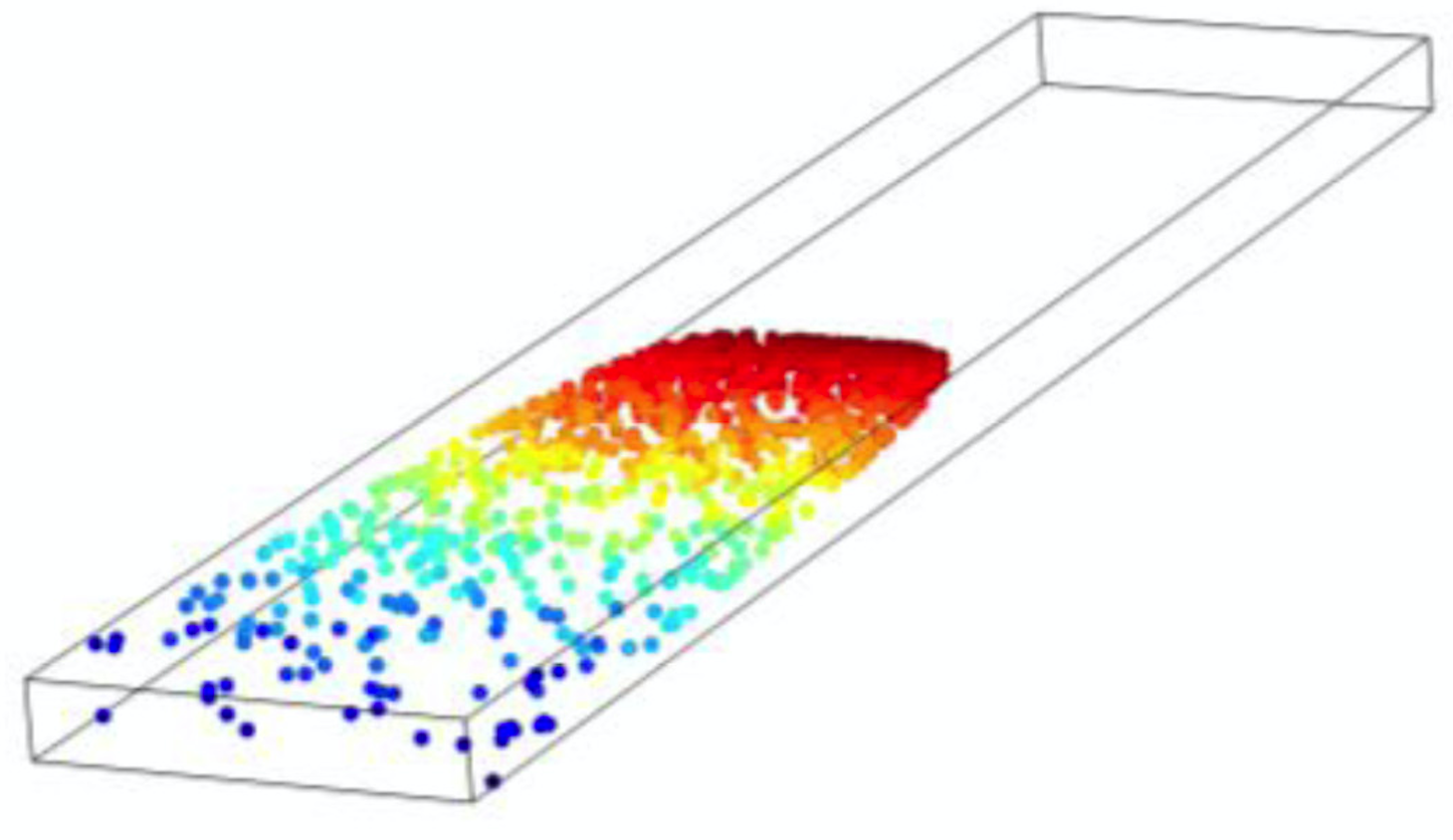 Behavior of non-Brownian particles. The color scale shows the instantaneous particle velocity. |
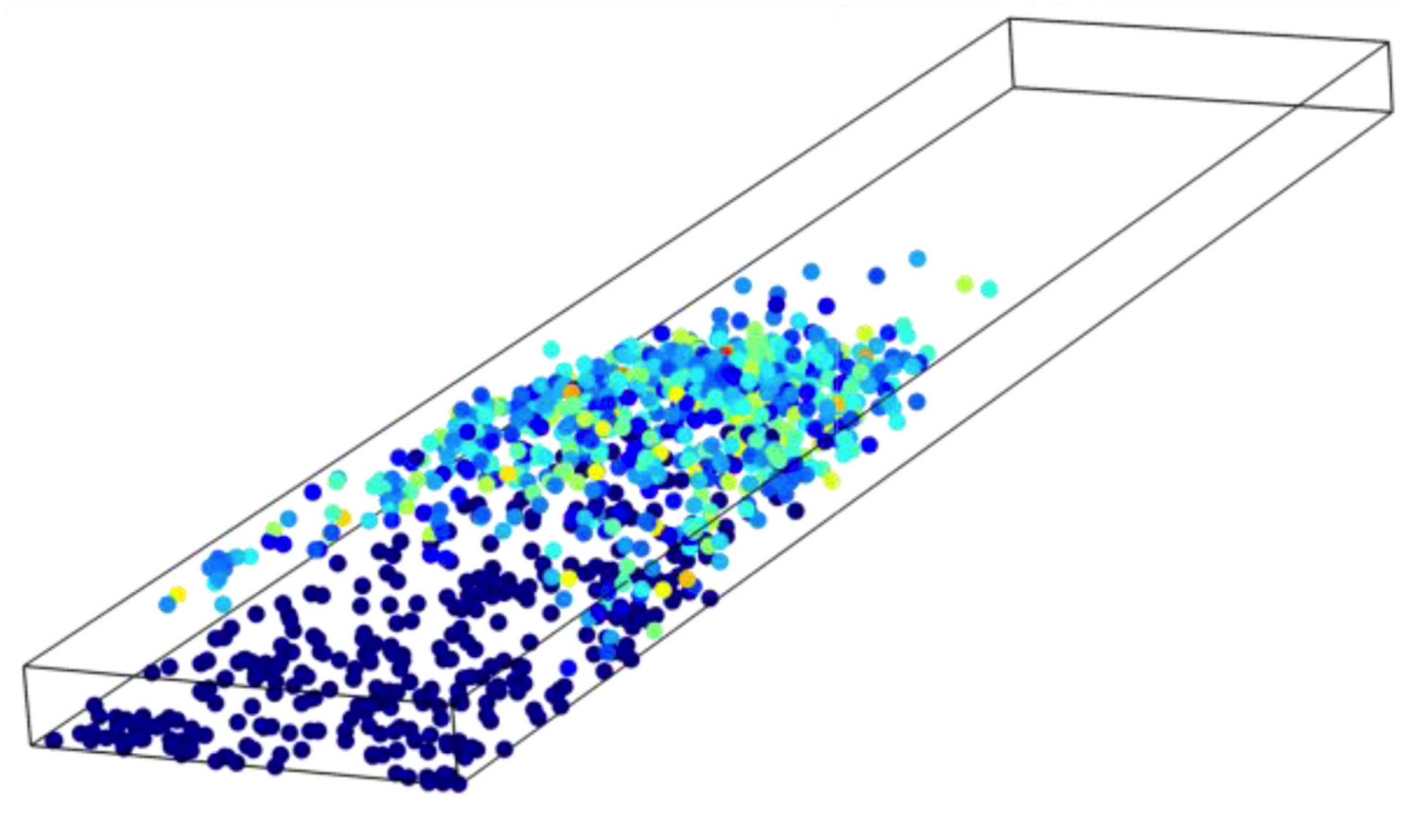 Behavior of Brownian particles. The color scale shows the instantaneous particle velocity. |
More recently, we carried out MITACS Accelerate projects on Rational Nanoparticle Design for Efficient Transmucosal Gene Delivery. By coordinating Brownian dynamics simulations and in vitro experiments, we studied the transport of lipid nanoparticles (LNPs) loaded with Cas9 mRNA or ribonucleoproteins. Varying the genetic cargo, mucin sialylation, mucin concentration, ionic strength, pH, and polyethylene glycol (PEG) coating, we identified key mechanisms for mucus-LNP interactions that are critical to the rational LNP design for transmucosal delivery. The short video below illustrates how the mucus pH affects the diffusion of mRNA-loaded LNPs in vitro:
 (Moderately acidic mucus, pH=5, offers optimal LNP diffusion.) |
We then focused on optimizing nanoparticle shapes to achieve desired delivery through the human airway mucus layer. Our results show that rodlike nanoparticles (RNPs) can diffuse up to 5 times faster than anticipated by the obstruction scaling model. We further discovered the causes of this discrepancy: RNPs spend more time in coarser regions of the gel than in denser regions, thus sampling a skewed pore-size distribution in favor of the larger pores. Moreover, they execute a meandering motion in the coarser regions, but a fast, predominantly longitudinal diffusion in the denser regions where rotation is severely constrained. The two modes of motion are illustrated by the graph below. Currently we are simulating NP diffusion in the cilia-driven flows of the mucus layer.
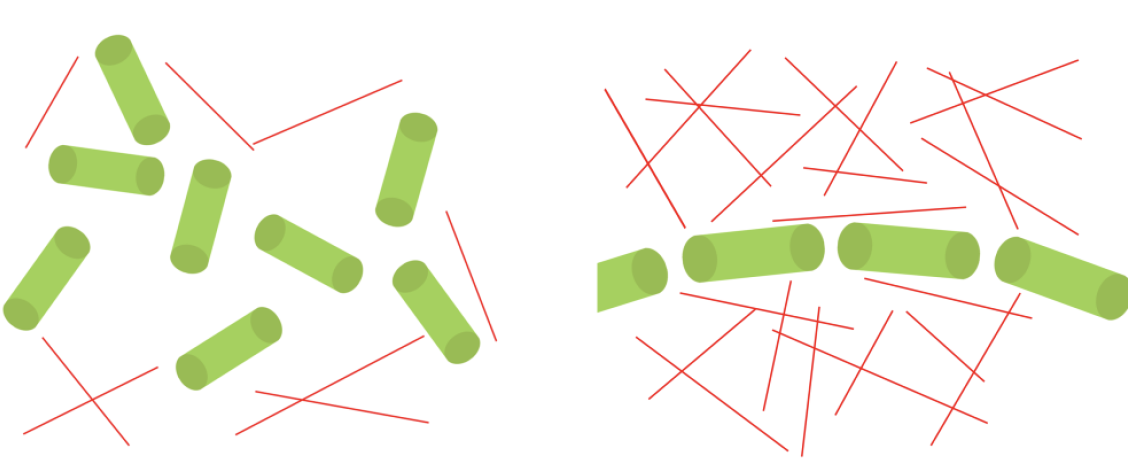 The meandering diffusion of nanorods in a coarser region of the gel (left), and the directional diffusion in a denser region (right). |